
A Drawer Full of Decisions
We’re all guilty…
No matter how organized we think we are, no matter how many times we’ve sworn we’re “clutter warriors,” there’s always that drawer – the one we avoid opening unless absolutely necessary.
My reckoning with my own “junk” drawer finally arrived after 24 years of cohabitation. It was on the eve of Move Out Day (we had sold our home after our son had left the nest), and I had avoided this confrontation for the last three weeks. I simply wasn’t ready to go there.
But I knew I had to make the first move, so I did.
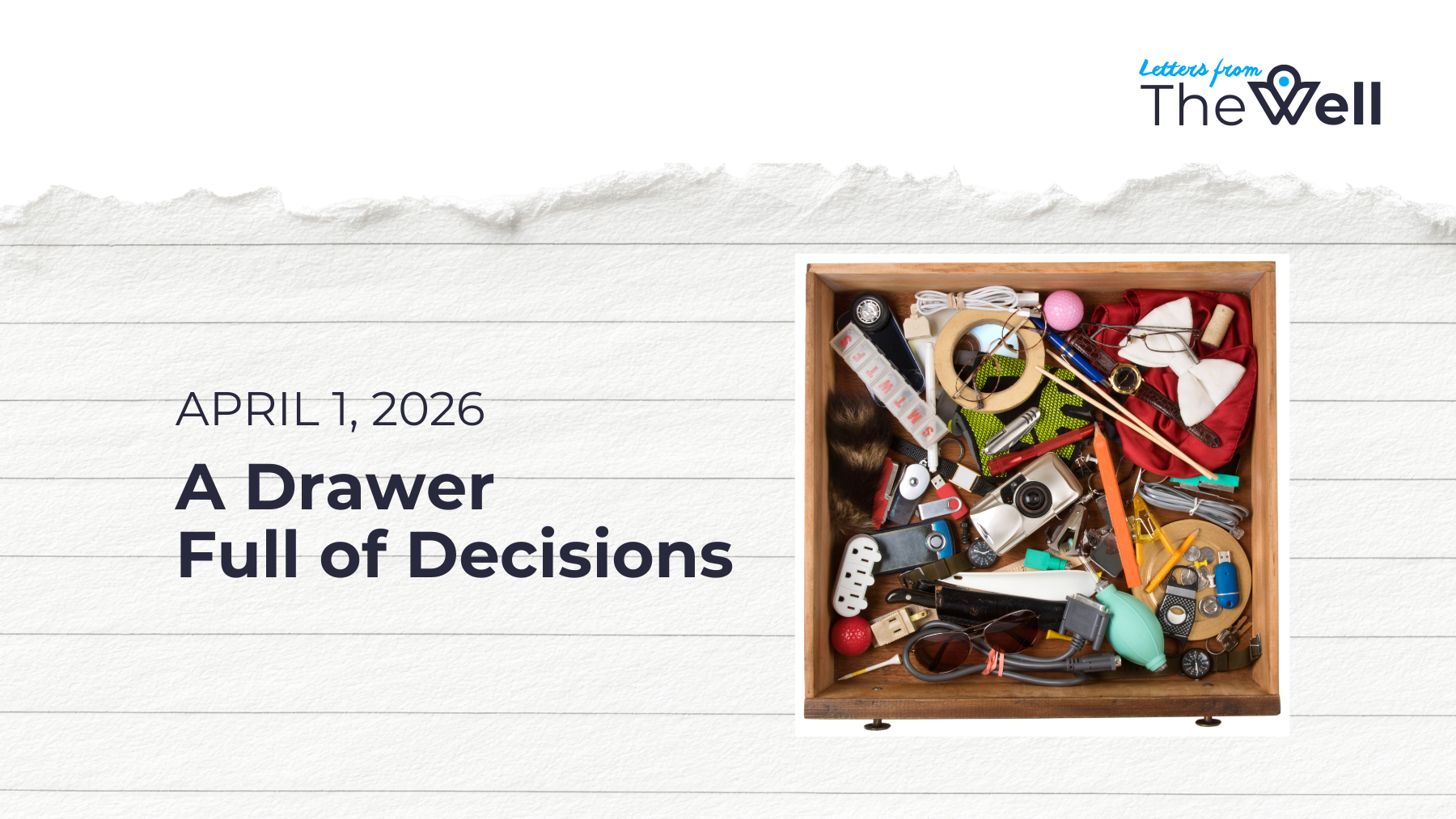
What I found was a hodgepodge of obsolete phone chargers, instruction manuals for appliances I wasn’t even sure I still owned, and mysterious parts to items unknown. I have to admit – the drawer possessed its own kind of unique order. The batteries were all in one tray (though I had no idea which were new and which were old), the nails and screws were tucked into a clear zip bag, and a jumble of cords had formed their own cohesive wad.
Rounding out this collection were vaguely familiar remotes, the screws that must belong to something important, and a stack of warranties that were most likely expired and most certainly invalid. This was the stuff in my life that had always felt too potentially useful to throw away. But now, on the last night I would be in this house, it all felt too mysterious to justify keeping, and too familiar to toss without hesitation.
The practice of purging is a huge part of moving for everyone, but here’s the thing no one really tells you: it’s not the big decisions that wear you down. It’s the tiny ones.
Do I need this charger?
What if I find the device it goes to later?
Should I keep this manual? What if I need to troubleshoot something someday?
Are these screws important, or are they just… screws?
Individually, each question is harmless…almost laughable. But stack a few dozen, or a few hundred, on top of each other, and suddenly you’re deep in decision fatigue. It is the kind of feeling that makes you want to sit back, close the drawer, and tell yourself you will deal with it later…except later has a way of turning into 24 years.
There is a distinct comfort in keeping things like this. Not because we love them, but because they represent a kind of preparedness. It is a soft and reassuring voice that says, You might need this someday, and if you do, you will be ready.
It is a form of control, really – a hedge against future inconvenience, against regret, and against the mild panic of realizing you threw away the one thing you now need. But there is also something deeper happening.
That drawer is not just a collection of objects; it is a record of decisions we have deferred. It holds little moments where we chose not to choose, where we said, I will deal with this another time, and then moved on with our lives.
Until moving day comes along and gently, but firmly, says, Actually, you won’t.
And suddenly, you are not just sorting cords. You are sorting time.
Because letting go of it means acknowledging that a version of your life is done and that you have moved on. It means admitting that you didn’t need it after all. And for some reason, that is harder than it sounds.
I remember holding up a random power adapter with no label and no recognizable purpose and feeling an absurd amount of hesitation. It was not because I thought I would use it, but because getting rid of it felt like closing a door I didn’t even remember opening.
Multiply that feeling by an entire drawer, and it becomes overwhelming very quickly.
This is where decision fatigue really shows its teeth. It is not just about being tired of choosing – it is about being tired of the weight behind each choice, even when the stakes are objectively low.
Our brains do not always distinguish well between “small” and “big” decisions, especially when they are layered with uncertainty, memory, and just enough “what if” to keep us stuck.
So we stall. We keep things. We postpone decisions…and the drawer grows.
What surprised me most during that move was not how much stuff I had, it was how much energy it took to let it go. I had always thought decluttering was a physical task, but it turns out it is almost entirely mental.
You are not just tossing objects; you are overriding instincts. You are challenging the intrinsic belief that more equals safer and that holding on is better than risking the regret of throwing something away.
So where do we find the strength to actually do it?
It probably does not come from a burst of motivation or a perfectly organized system. It comes from a shift in perspective.
At some point, sitting there surrounded by piles of “maybe,” I realized something: the cost of keeping everything was not just space…it was energy.
Every item I held onto a random cord or ambiguous piece of plastic, it was another small, unresolved decision waiting for me in the future. It was another moment of friction and another tiny weight I did not need to carry forward.
And when I looked at it that way, letting it go did not feel like loss. It felt like relief.
Not because I was becoming some minimalist overnight, but because I was choosing clarity over contingency. I was trusting that future me would figure things out, just like present me always has.
It dawned on me that I did not need a drawer full of “just in case” to be okay, and I let myself sit in that realization. I did not want to forget that feeling, especially since I was moving forward in a new stage of life.
But do not assume I became ruthless in my sorting. I still kept a few cords and a couple of manuals…I am only human. But the difference was intentionality. Instead of defaulting to “keep,” I started asking, Is this actually serving me, or am I just avoiding the decision?
More often than not, the answer was clear.
By the end of the evening, the drawer was not completely empty, but it was considerably lighter, and the contents fit neatly into one shoebox. It felt manageable. Contained. I considered it a victory.
That is the thing about clutter relief – it always ends up feeling much more remarkable than it looks. It is never just about the drawer, or the closet, or the garage. It is about reclaiming a little bit of mental space, a little bit of agency, and, most importantly, a little bit of peace.
Perhaps that is why we hold onto these things for so long. It is not because we need them, but because deciding not to need them feels significant.
And it is.
But it is also attainable.
Sometimes, it begins with something as simple, and as unexpectedly difficult, as the junk drawer.

For the in-between seasons.
If you’re navigating change — helping a parent, preparing to downsize, or stepping into a new chapter — we write thoughtful letters for moments like this.